
Storeganise vs Tenant Inc: Which One Actually Fits How You Run Your Business?
By the time most operators compare Storeganise vs Tenant Inc self storage, they’re no longer exploring, they’re evaluating risk.
Because switching software in self storage is not a small decision.
It impacts:
How quickly you fill units
How efficiently your team operates
How much revenue you leave on the table
And more importantly, it defines how your business scales over the next 3–5 years.
Most comparison articles won’t tell you that.
They’ll list features. Maybe pricing. Sometimes integrations.
But what they don’t explain is how these platforms behave inside a real operation: when your team is busy, when leads come in after hours, or when you’re trying to scale without doubling your staff.
This isn’t a surface-level breakdown. This is about how each platform actually behaves inside a real operation and which one aligns with how you plan to grow.
Quick Verdict: Storeganise vs Tenant Inc
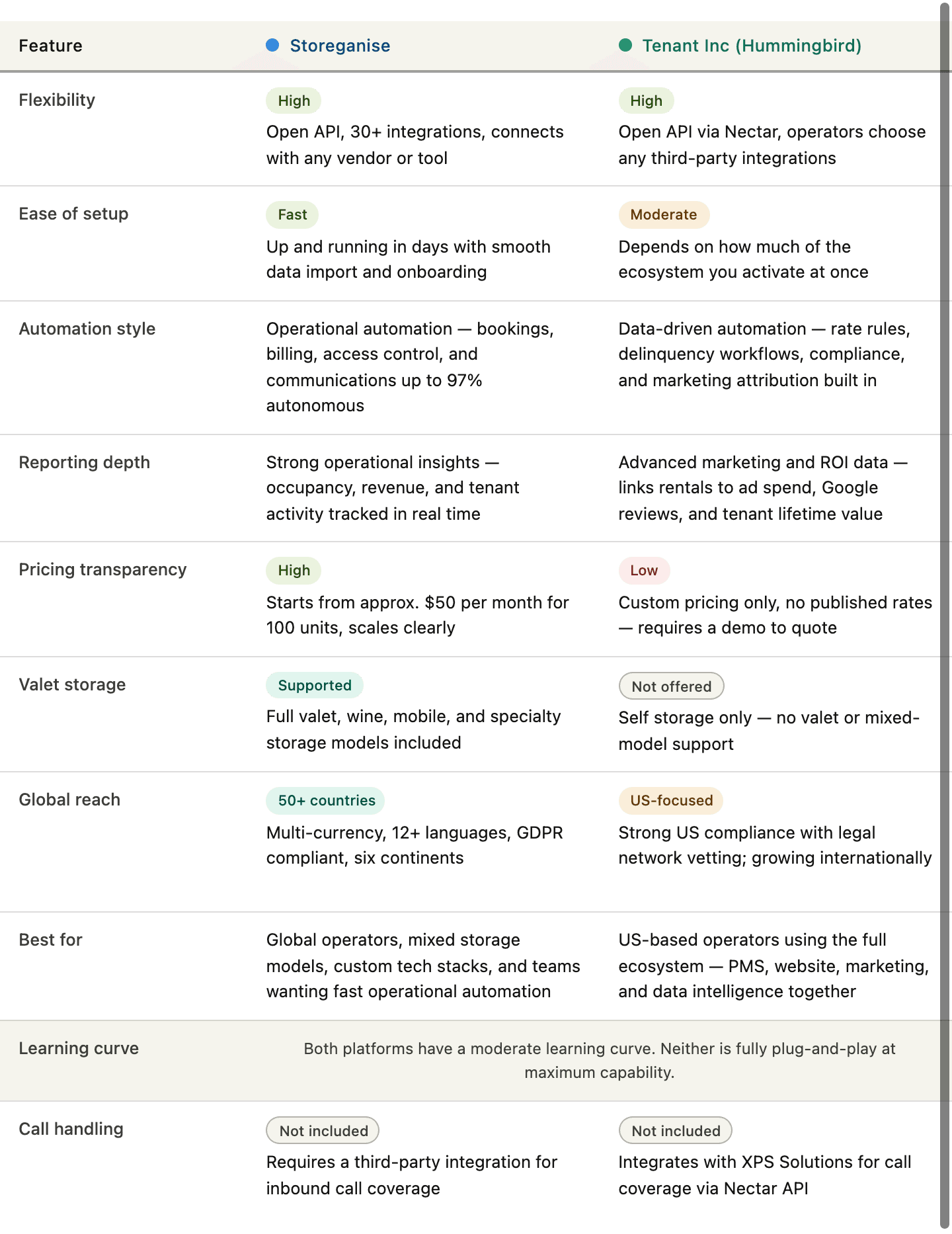
The Core Difference Most Comparisons Miss
Before features, pricing, or UX, there’s a deeper distinction:
Storeganise and Tenant Inc are built on completely different operating philosophies.
Storeganise is built like a flexible engine.
Tenant Inc is built like a closed ecosystem.
That single difference explains almost everything that follows.
Storeganise: Build It Your Way
Storeganise is designed as a modular, adaptable system and gives you control.
Open API
30+ integrations
Traditional self storage
Works across 50+ countries
Supports valet, mobile, and hybrid storage
It’s used in 50+ countries across 1,200+ facilities, which immediately tells you something important:
It’s not built around one market or one way of operating.
It’s designed for operators who want to shape their own stack. Think of it like a customizable operating system. But flexibility comes with responsibility. You have more control but also more decisions to make.
Tenant Inc: Everything Under One Roof
Tenant Inc takes a completely different approach.
Instead of giving you tools to build your system, it gives you a system already built.
The ecosystem includes:
Hummingbird (property management)
Mariposa (website + front-end experience)
Nectar (data warehouse)
Marketing services
Everything is designed to work together without external dependencies.
This creates:
Consistency
Standardization
Predictability
But it also means you are operating inside their framework. Think of it like an all-in-one platform where you don’t need external tools.
Pricing Isn’t Just About Cost — It’s About Structure
Most comparisons stop at numbers. But pricing models shape how you scale. It’s about long-term commitment and operational structure.
Storeganise: Predictable and Accessible
Storeganise starts around $50–$90/month for smaller facilities and scales with:
Unit count
Features Usage
Locations
For mid-sized operators (500–2,000 units), expect roughly $200–$800/month depending on configuration.
What makes this model effective:
Clear pricing tiers
No heavy upfront commitment
Easy to scale gradually
Operators consistently highlight predictability as a key advantage.
Tenant Inc: Value Comes From the Stack
Tenant Inc doesn’t publish pricing publicly.
From operator discussions:
Setup fee + monthly cost
Pricing increases with ecosystem usage
Often compared as “bundled value” vs separate tools
However, the important detail is this:
Tenant Inc replaces multiple tools:
Website platform
Marketing tools
Data analytics systems
The key point:
Tenant Inc only becomes cost-effective if you use multiple components together.
If you only need a PMS, it can feel expensive. If you use the full ecosystem, it can replace 3–4 tools.
Pricing Reality Check:
Want control + predictable cost → Storeganise
Want bundled system → Tenant Inc
The biggest hidden cost in self storage software is not pricing.
It’s time.
Day-to-Day Experience: What It Actually Feels Like
Software decisions are rarely made on features.
They’re made on friction.
Storeganise: Fast, Functional, Efficient
Storeganise is consistently described as:
Clean but feature-dense
Easy to onboard (days, not weeks)
Highly automatable
Operators report Storeganise runs 97% of operations automatically, including:
Billing
Customer communication
Booking workflows
The trade-off?
Slight learning curve upfront
No dedicated mobile app (a recurring complaint)
Tenant Inc: Designed Around the Customer Journey
Tenant Inc focuses heavily on tenant experience.
From forums and operator feedback:
Online rentals can take 5–10 minutes end-to-end
Identity verification is built-in
Website → booking → access flow is seamless
This is where Tenant stands out.
But internally:
Setup can take longer
More configuration needed to unlock full value
UX Insight:
For internal efficiency → Storeganise
For customer journey → Tenant Inc
Automation: Two Very Different Approaches
Both platforms automate. But not in the same way.
Storeganise: Reduce Manual Work
Storeganise focuses on operational automation:
Auto billing and invoicing
Payment reminders
Workflow triggers
AI booking assistant
Operators report significant time savings, especially in admin-heavy tasks.
Tenant Inc: Optimize Revenue
Tenant Inc goes deeper into data-driven automation.
Examples include:
Dynamic pricing based on occupancy
Automated promotions
Marketing attribution tracking
One case study showed:
+6.2% occupancy increase
+12.7% AutoPay adoption
+12.6% protection plan growth
This is automation tied directly to revenue.
Automation Verdict:
Want less work → Storeganise
Want smarter pricing & growth → Tenant Inc
Integrations vs Ecosystem: A Strategic Decision
This is where most operators make the wrong call.
Storeganise: Open Integration Model
30+ integrations
Works with tools like QuickBooks, Xero
Connects with marketing platforms
Open API for custom builds
Ideal if you:
Use multiple tools
Run paid ads
Need flexibility
Tenant Inc: Closed Ecosystem Advantage
Tenant Inc reduces the need for integrations by offering everything internally.
Instead of integrations, it offers:
Native website builder
Built-in marketing tools
Centralized data system
The benefit:
Everything works together
No compatibility issues
Unified data flow
Simplified tech stack
The limitation:
Less flexibility outside the ecosystem
Harder to replace individual components
Strategic Insight:
This isn’t a feature comparison. It’s a business decision:
Best-of-breed stack → Storeganise
All-in-one simplicity → Tenant Inc
Reporting: Operational vs Strategic Insight
Both platforms provide data but they answer different questions.
Storeganise: Know What’s Happening
Storeganise gives you:
Occupancy
Revenue
Payment tracking
Unit availability
It answers:
“What’s going on inside my facility?”
Tenant Inc: Know Why It’s Happening
Tenant Inc connects:
Ads → bookings
Reviews → occupancy
Channels → ROI
It answers:
“Why is my business performing this way?”
Reporting Insight:
Operational clarity → Storeganise
Growth intelligence → Tenant Inc
What Real Operators Say (Unfiltered)
Across Reddit, Facebook, forums, and review sites, patterns are consistent.
Storeganise Self Storage Solutions Review
Strengths:
Reliable
Easy to use
Strong automation
Weaknesses:
No mobile app
Limited marketing attribution
“You can automate everything… UI is nice.”
Tenant Inc Self Storage Solutions Review
Strengths:
Powerful ecosystem
Strong data insights
Great tenant experience
Weaknesses:
Bugs during rollout
Integration challenges
Learning curve
“Game changer… but still being refined.”
The Real Insight:
Operators don’t compare features.
They compare fit.
And most issues come from choosing the wrong type of system, not a bad system.
Who Should Use Storeganise?
Storeganise is best for operators who value flexibility and control.
You should choose it if you:
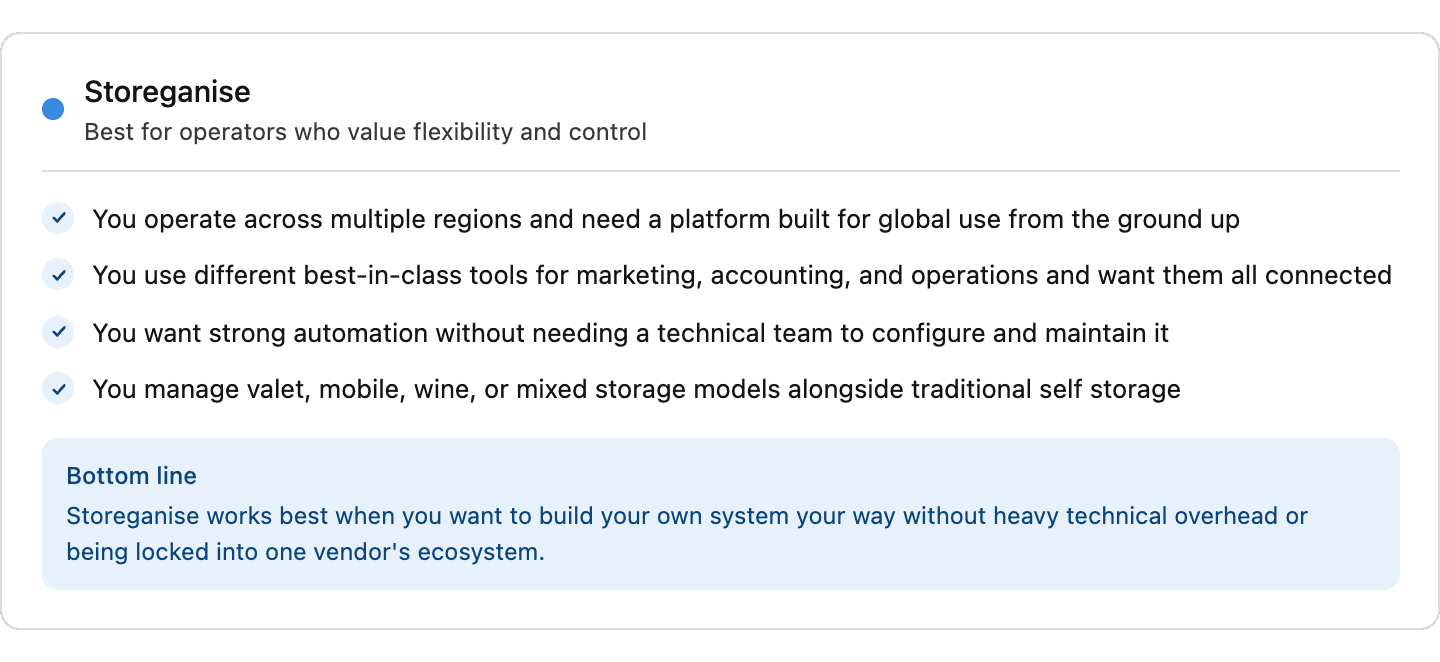
Operate in multiple regions
Use different tools for marketing, accounting, and operations
Want automation without complexity
Storeganise works best when you want to build your own system without heavy technical overhead.
Who Should Use Tenant Inc?
Choose Tenant Inc if you want a fully connected business.
You should choose it if you:
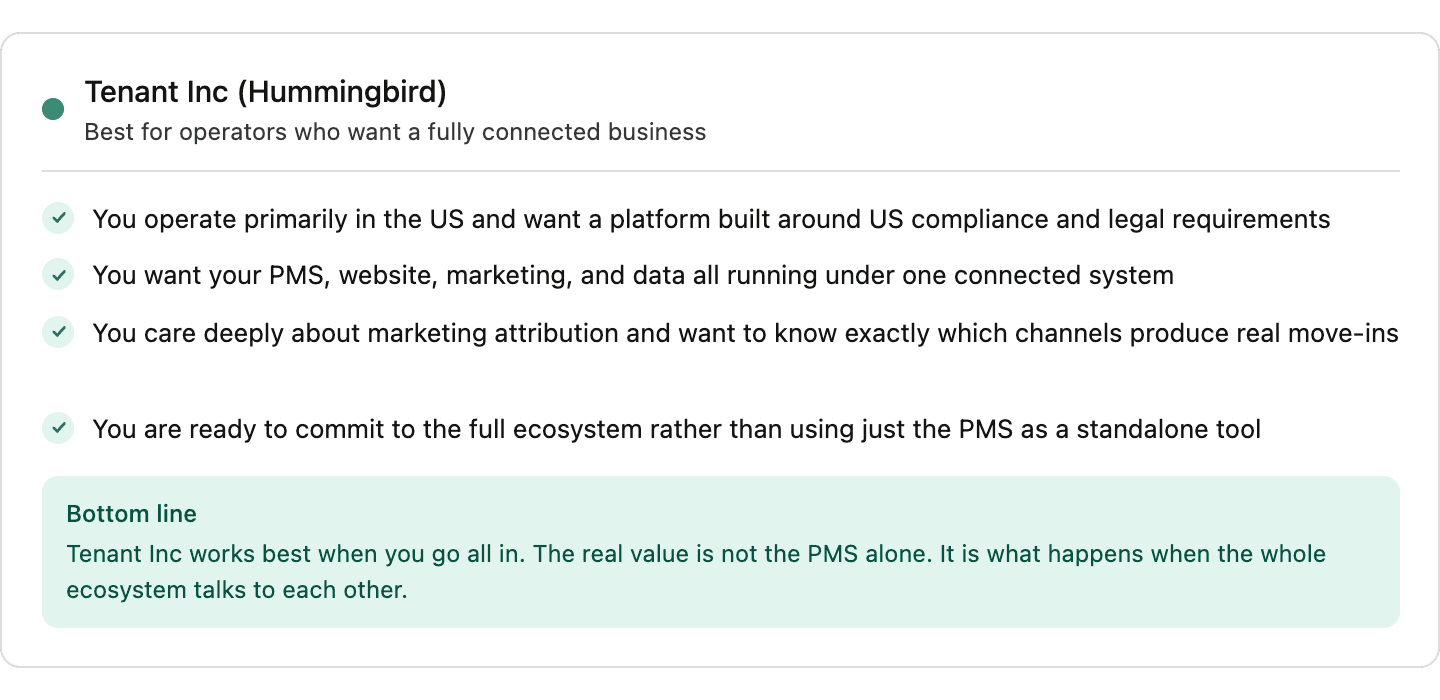
Operate primarily in the US
Want everything under one system
Care about marketing attribution and data
Tenant Inc works best when you commit to its full ecosystem, not just the PMS.
The Gap Both Platforms Still Leave Open
Both Storeganise and Tenant Inc solve a big part of the operational problem.
They help you:
Manage units
Automate billing
Track performance
But neither solves what happens before all of that:
The moment a customer calls.
Industry data shows up to 40% of calls go unanswered, especially:
After hours
During peak times
When staff is busy
That’s not just a missed call. That’s a lost tenant.
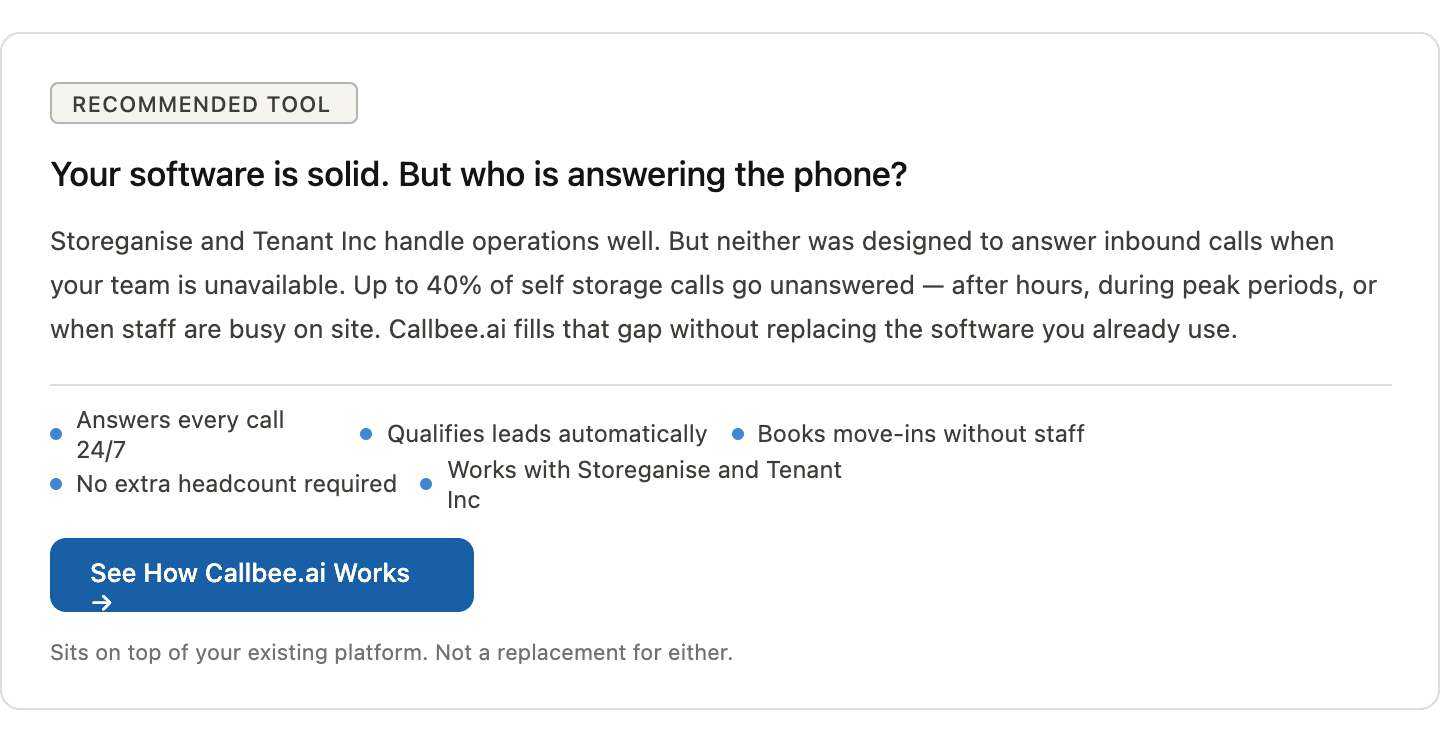
Callbee.ai fills that gap.
It acts as an AI receptionist built specifically for self storage:
Self Storage Answering Service 24/7
Qualifies leads
Books move-ins automatically
It doesn’t replace Storeganise or Tenant Inc. It sits on top of them. If your software is strong but your phone still goes unanswered, this is the missing layer.
FAQ
Which is better: Storeganise or Tenant Inc?
Neither is universally better. Storeganise offers flexibility and automation, while Tenant Inc provides a fully integrated ecosystem. The right choice depends on how you run your business.
Is Tenant Inc more expensive than Storeganise?
Generally yes, especially if you only use part of its ecosystem. It becomes more cost-effective when using the full platform.
Can Storeganise handle large operations?
Yes. Storeganise is used by 1,200+ facilities globally and supports multi-location operations with strong automation.
Does Tenant Inc include marketing tools?
Yes. Tenant Inc includes website building, marketing services, and a data warehouse for tracking performance.
Do either platforms include call centre software?
No. Neither includes built-in self storage call centre software, which means missed calls remain a gap.
Is an AI receptionist useful for storage businesses?
Yes. An AI receptionist for self storage ensures no lead is missed and can significantly improve conversion rates without increasing staffing costs.